
We cannot stop the march of time, but our perception of time can shrink or stretch. Researchers at the Weizmann Institute of Science recently uncovered a new cognitive bias: The way in which we experience the passage of time can be distorted by a process where we learn to adjust our expectations.
When we are surprised for the better that feeling may seem to last longer than the clock reflects, while an unwelcome surprise may seem to take place in less time.
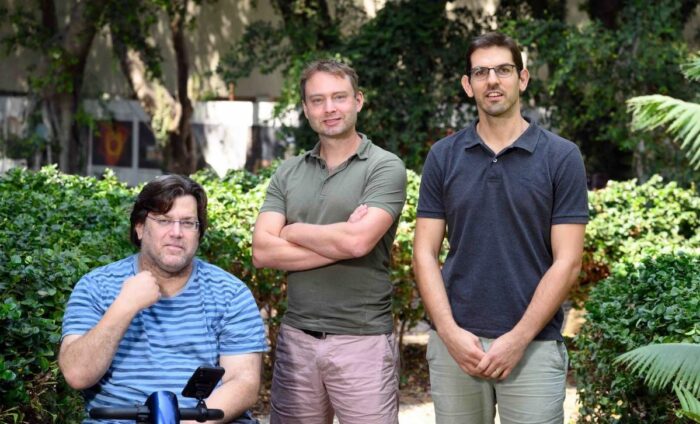
Weizmann’s Professor Rony Paz and his group in the Institute’s Neurobiology Department have found an intriguing connection between the sense of time and learning recently published in Nature
Our brain has an amazing capacity for learning. It continually learns from experience and adjusts expectations, comparing what we expect to find with what we actually receive. A mismatch between what we expect and what we receive is known as a prediction error. The neural mechanism for dealing with such errors is found in circuits deep in our brains, in the basal nuclei, and operated by the neurotransmitter dopamine. Incidentally – or so it has been thought until now – similar circuits are responsible for our sense of time.
This extends to the split-second timing we need to coordinate motor activities, and our sense of time is crucial to learning, involving creating associations, narratives and causal relations between things that occur close together in time.
Research student Ido Toren in Paz’s lab group wondered whether the fact that two different processes occur in the same neural circuits means that one might affect the other. Indeed, there is evidence that in such disorders of the dopamine system as Parkinson’s, schizophrenia and attention deficit disorder, disruptions to the ability to learn are accompanied by an impaired sense of time.
Toren and Paz planned a clever experiment in which these two processes are independent, and then tested whether one of them interferes with the other. Volunteers were asked to look at pairs of slides and to estimate which one was shown for a longer period of time. The numbers on the slides were monetary sums that the subjects would supposedly receive – or lose if the number was negative. The sums were independent of the time judgement – they were allotted regardless of the accuracy of the estimates, and the subjects were not even told whether their estimates were close to the mark. At first, the pairs of numbers – for example a 4 following a 0 – were repeated several times so as to create a certain expectation. Then, every once in a while, the second slide would defy those expectations with a larger number, a lower one – or even a negative one.
The researchers observed that the introduction of prediction errors resulted in distortions in the perception of time. When the subjects received more than they expected, they perceived the length of time that number was shown to them as longer than it actually was; when they got less than expected their perception told them less time had elapsed. In other words, a positive prediction error (unexpected extra payout) returned a larger time estimate while negative prediction error (less than expected) produced a feeling of less time. That is, more reward means more time.
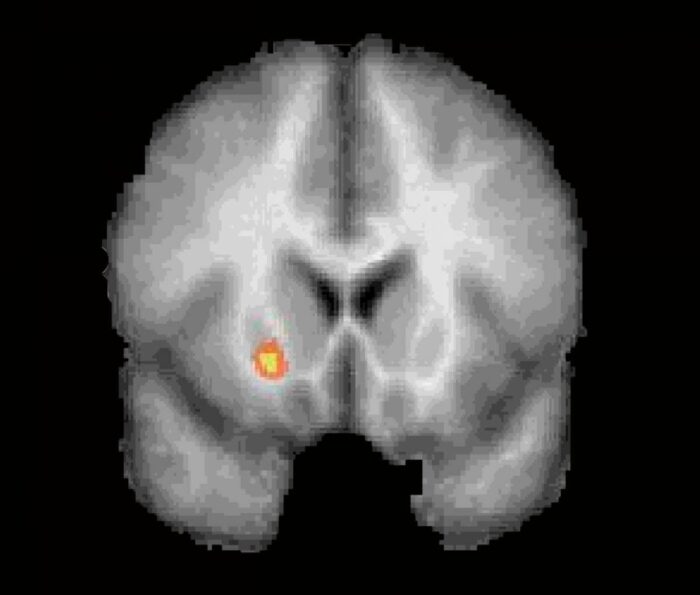
Next, the researchers scanned the brains of volunteers in the Institute’s functional magnetic resonance imaging (fMRI) equipment and developed a computational model to explain the behavior and examine brain correlates. They found that this interactions between the prediction errors that drive learning and the distorted sense of time takes place within a structure deep in the brain called the putamen, a part of the basal nuclei.
The main effect of the prediction error was observed in the putamen, a part of the basal nuclei
Even as our brain learns from mistakes, it makes new mistakes of its own. Some of our biases have been found to have evolutionary benefits, and this new bias could also confer some sort of benefit on our survival.
“We showed that two separate processes that take place in the same location in the brain could be connected,” said Toren.
“Now we want to understand why this happens. Could it simply be a side effect of using the same neurons for two tasks? The consistency of the directionality of the bias, as well as the deep connection between it and the learning process, suggest there could be something more to understand about the reasons for this bias.”
The findings may also explain why in many disorders of the dopamine system or those affecting neural circuits in the basal nuclei, impairment of the ability to learn or in motor movement may by accompanied by distortions in the perception of time.
Also participating in this research was Dr Kristoffer Aberg, a postdoctoral fellow in Paz’s lab.