
Ask Brian Berkowitz about the fruits of his research – say, an environmentally friendly way to remove pollutants from contaminated water – and he’ll stop you.
“OK. I have to go back a little bit,” he tells me. “I’m at the Weizmann Institute of Science, and the mandate is basic research, basic, curiosity-driven scientific research. So rather than try to solve a particular problem and directing research, we do the basics, understand basic phenomena and once you understand them, then we end up inevitably coming up with various solutions.”
Berkowitz, head of the institute’s Department of Earth and Planetary Sciences, was in the Valley to deliver his presentation “Hard to Swallow: Ensuring Safe Drinking Water for Our Community” at two private gatherings organized by the American Committee for the Weizmann Institute of Science. This allowed him to beat the drum for basic research.
“That’s where a lot of disruptive technologies come from,” he says. “When I call it disruptive, it’s not an incremental change because it’s a totally out-of-the-box way of looking at a problem. So I’ve never actually set out saying, ‘Here’s a particular problem. How do we solve it?’ That’s the wrong way to do it. More often than not, you’re going to fail because you’re so fixed on trying to do it, you don’t get out of the rut.” That rut becomes an obstacle to what he calls “eureka moments” that arise from studying and understanding phenomena.
“I had an explosion in the laboratory and things blew up on me … when we realized what had happened, we then said, ‘Hey. This is a neat result, a neat phenomenon.’ Once we understood it, we were then able to turn that into an actual technology.”
It turns out to be a funny story: The researchers sealed test tubes full of gasoline and nanoparticles (particles ranging from 1 to 100 billionths of a meter in size) of metal oxide and went out for lunch. When they returned, they found the test tubes had exploded with such force that glass shards were sticking in the walls.
In studying what happened, they learned that the gasoline had been turned into carbon dioxide. They soon learned to control the reactions and are now at the point where they can take any industrial waste effluent and, through these reactions, clean up what had once been very toxic contaminated water enough so that it can be sent safely to municipal wastewater treatment.
In a wide-ranging discussion, he talks about similar eurekas that have produced promising results in breaking down pesticides so they can be used in agriculture, and “self-destruct” into nontoxic materials in the soil before they can contaminate aquifers. A similar problem exists with drugs and antibiotics, which get into the water system through various means, including simply going to the bathroom (about 90 percent of the drugs we take pass out of the body through urination).
Why does he stress basic research?
“People don’t like the idea to, say, ‘Give to academics. Give them money, and let them do the basic research,’ because it’s not a business model” with an expected return on investment.
However, he points out that the basic research behind technologies such as magnetic resonance imaging (MRI) and microwave ovens was done 40 to 50 years before actual products were developed.
“It’s not a standard business model, but humanity gains in this,” he says.
http://www.weizmann-usa.org/media/2015/01/07/weizmann-scientist-stresses-value-of-eureka-moments
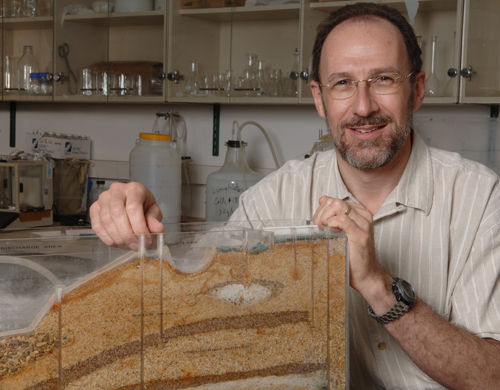
Brian Berkowitz is a professor at the Weizmann Institute of Science and head of its Department of Earth and Planetary Sciences. Photo courtesy of the Weizmann Institute


