Non-nutritive sweeteners – also known as sugar substitutes or artificial sweeteners – are supposed to deliver all the sweetness of sugar without the calories. But a controlled trial conducted by Weizmann Institute of Science researchers, published this week in Cell, suggests that contrary to previous belief, such sweeteners are not inert: They do have an effect on the human body.
In fact, some can alter human consumers’ microbiomes – the trillions of microbes that live in our gut – in a way that can change a person’s blood sugar levels. And the effects these sweeteners produce vary greatly among different people.
In 2014, a Weizmann Institute study in mice had shown that some non-nutritive sweeteners might actually be contributing to changes in sugar metabolism that they are meant to prevent. In the new trial, a team of researchers headed by Professor Eran Elinav of Weizmann’s Systems Immunology Department screened nearly 1,400 potential participants, selecting 120 who were found to strictly avoid any artificially sweetened foods or drinks.
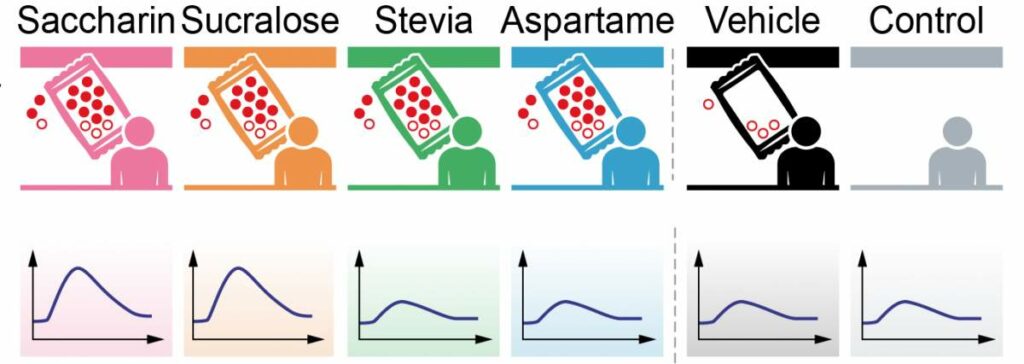
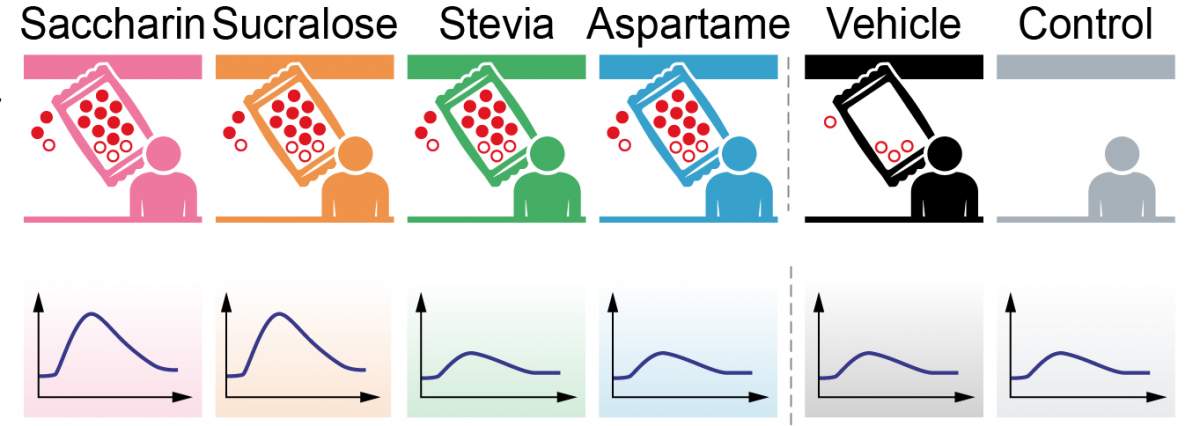
The volunteers were then divided into six groups. Participants in four of the groups were handed sachets of common non-nutritive sweeteners, containing amounts that were lower than the acceptable daily intake, one sweetener per group: saccharin, sucralose, aspartame or stevia. The two other groups served as controls.
The research was led by Dr Jotham Suez, a former graduate student of Elinav’s and now principal investigator at the John Hopkins University School of Medicine, and Yotam Cohen, a graduate student in Elinav’s lab; it was conducted in collaboration with Professor Eran Segal of Weizmann’s Computer Science and Applied Mathematics and Molecular Cell Biology Departments.
The researchers found that two weeks of consuming all four sweeteners altered the composition and function of the microbiome and of the small molecules the gut microbes secrete into people’s blood – each sweetener in its own way.
They also found that two of the sweeteners, saccharin and sucralose, significantly altered glucose tolerance – that is, proper glucose metabolism – in the recipients. Such alterations, in turn, may contribute to metabolic disease. In contrast, no changes in either the microbiome or glucose tolerance were found in the two control groups.
The changes induced by the sweeteners in the gut microbes were closely correlated with the alterations in glucose tolerance.
“These findings reinforce the view of the microbiome as a hub that integrates the signals coming from the human body’s own systems and from external factors such as the food we eat, the medications we take, our lifestyle and physical surroundings,” Elinav said.
To check whether changes in the microbiome were indeed responsible for impaired glucose tolerance, the researchers transplanted gut microbes from more than 40 trial participants into groups of germ-free mice that had never consumed non-nutritive sweeteners.
In each trial group, the transplants had been collected from several ‘top responders’ (trial participants featuring the biggest changes in glucose tolerance) and several ‘bottom responders’ (those featuring the least changes in glucose tolerance). Strikingly, recipient mice showed patterns of glucose tolerance that largely reflected those of the human donors. Mice that received microbiomes from the ‘top responders’ had the most pronounced alterations in glucose tolerance, compared to mouse recipients of microbiomes from ‘bottom responders’ and from human controls.
In follow-up experiments, the researchers determined how the different sweeteners affected the abundance of specific species of gut bacteria, their function and the small molecules they secrete into the bloodstream.
“Our trial has shown that non-nutritive sweeteners may impair glucose responses by altering our microbiome, and they do so in a highly personalized manner, that is, by affecting each person in a unique way,” Elinav said.
“In fact, this variability was to be expected, because of the unique composition of each person’s microbiome.”
Elinav added: “The health implications of the changes that non-nutritive sweeteners may elicit in humans remain to be determined, and they merit new, long-term studies. In the meantime, it’s important to stress that our findings do not imply in any way that sugar consumption, shown to be deleterious to human health in many studies, is superior to non-nutritive sweeteners.”
Study participants included Dr Rafael Valdés-Mas, Uria Mor, Dr Mally Dori-Bachash, Dr Sara Federici, Dr Niv Zmora, Dr Avner Leshem, Dr Melina Heinemann, Raquel Linevsky, Maya Zur, Rotem Ben-Zeev Brik, Aurelie Bukimer, Shimrit Eliyahu Miller, Alona Metz, Ruthy Fischbein, Olga Sharov and Dr Hagit Shapiro from Elinav’s lab; Drs. Sergey Malitsky and Maxim Itkin from Weizmann’s Life Sciences Core Facilities Department; Dr Noa Stettner and Professor Alon Harmelin from Weizmann’s Veterinary Resources Department; and Dr Christoph K. Stein-Thoeringer from the Microbiome & Cancer Division, German Cancer Research Center (DKFZ).