
Weizmann Institute of Science Ranked Eighth in the World for Research Quality

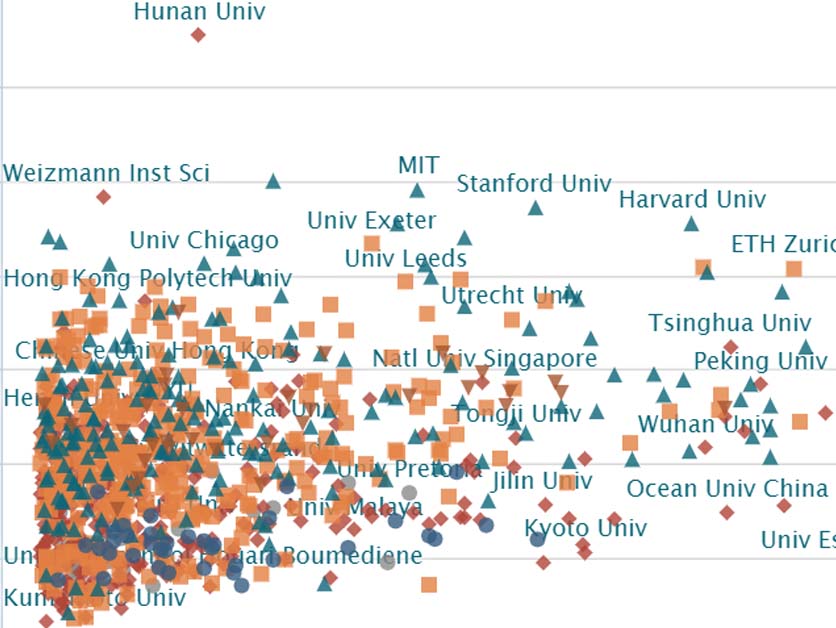
The Weizmann Institute of Science has been ranked eighth globally for research quality in a weighted (proportional) ranking conducted by the Centre for Science and Technology Studies (CWTS) of Leiden University, the Netherlands.

The Weizmann Institute is one of only two institutions outside the United States in the top ten (the other is Shandong University, China, which was ranked tenth). In the sub-ranking for Life and Earth Sciences, the Weizmann Institute of Science was ranked fourth in the world.

Along with other scientific achievements, the survey’s findings will be presented in the coming weeks at the Weizmann Institute’s 72nd Annual General Meeting of the International Board, held online for the first time, due to the COVID-19.

The Leiden Ranking is purely quantitative, and does not use subjective surveys. The data encompass the number of the scientific publications by scientists from the various universities and research institutes, the number citations for scientific papers – indicating the quality of the research – as well as information about the size of the institutions.

The current ranking indicates a significant increase in the quality of research at the Weizmann Institute of Science in recent years – from 17th place a little over a decade ago, to eighth in the current ranking.

Other figures from the Leiden 2020 ranking:

  • 20% of the papers authored by Institute scientists were ranked in the top 10% for scientific impact.
  • 24% of the papers authored by Institute scientists in the Life and Earth Sciences were ranked in the top 10% for scientific impact.
  • Over 20% of the papers authored by Institute scientists in the Biomedical and Health Sciences were ranked in the top 10% for scientific impact.
  • 5% of the scientific papers by Institute scientists were in the top percentile of papers for scientific impact, and 65.8% of them were in the top half of the papers with the greatest impact.
  • Between 2015-2018, scientific papers authored by Institute scientists earned 36,129 citations.
Share this article

[addtoany]

Latest news

A Magnetic Clue to Life’s Origins

A Magnetic Clue to Life’s Origins

A new study suggests that magnetic surfaces may influence not only the ‘handedness’ of biological molecules, but also their isotope composition – connecting two fundamental fingerprints of life. The study, offering new clues to the origin of life on Earth, began at a...

One Plant, Three Kingdoms, Five Trips

One Plant, Three Kingdoms, Five Trips

Weizmann Institute scientists have deciphered how a well-known psychedelic substance is created, and now they have engineered a plant to produce several psychedelics at once. Long before scientists began studying them in the lab, mind-altering substances were already...

Before the Aliens, the Amino Acids

Before the Aliens, the Amino Acids

A Weizmann-led team has proposed a simple but powerful new method for detecting traces of alien biology, whether on Jupiter’s icy moons, in meteorites or in Martian samples. Before any wrinkled, wide-eyed creature from a distant civilisation asks to be taken home, the...

Pandemic in Fast Forward

Pandemic in Fast Forward

Israeli and Czech scientists have recreated the coronavirus’ evolutionary journey in a test tube – revealing the conditions that can produce highly contagious variants. A key step in the origin of many pandemics occurs when an animal-borne virus infects humans and...

Facing Danger with Maturity

Facing Danger with Maturity

Weizmann Institute of Science and Hebrew University of Jerusalem scientists have discovered that stem cell maturation can also serve as an immune defence mechanism. We all begin life as a collection of embryonic stem cells that have a remarkable ability to mature into...

A Journey to the Centre of the Liver

A Journey to the Centre of the Liver

A first-of-its-kind genetic atlas, developed by scientists at the Weizmann Institute of Science, together with colleagues at Sheba Medical Center and the Mayo Clinic, reveals how human liver cells divide their labour – and why some regions are especially vulnerable to...