The Weizmann Institute of Science’s key Australian partner – The Garvan Institute of Medical Research – has appointed leading immunology scientist, Professor Chris Goodnow FAA FRS, as its next Executive Director.
In his congratulations, Weizmann Australia’s Chairman, Mr Stephen Chipkin, said the appointment was fitting for the Garvan-Weizmann partnership as Professor Goodnow played a lead role in its creation.
“How seamless, how good for Garvan and for the Garvan-Weizmann partnership. All best wishes to you in your new role. I look forward to our growing and closer connections,” said Mr Chipkin.
Considered one of Australia’s most outstanding scientists, Professor Goodnow is an internationally recognised expert in the immune system. Throughout his career he has pioneered the use of DNA technology and genome sequencing to reveal how the immune system distinguishes between ‘self’ and ‘non-self’ – and, in particular, how these processes go awry in autoimmune disease.
Professor Goodnow is currently Deputy Director of Garvan, and Head of the Immunogenomics Laboratory in Garvan’s Immunology Division. He holds The Bill and Patricia Ritchie Foundation Chair, is Conjoint Professor at UNSW Sydney in the St Vincent’s Clinical School (Faculty of Medicine), and is an NHMRC Senior Principal Research Fellow.
Professor Goodnow succeeds Professor John Mattick AO FAA as Executive Director, assuming his new role as Executive Director upon the completion of Professor Mattick’s Directorship.
Dr John Schubert AO, Chairman of Garvan, said that Professor Goodnow’s appointment would see the Institute go from strength to strength in its mission to make major impacts on human health through medical research and would cement Garvan’s position as the leading genomics centre in Australia.
“As a Board, we are unanimously delighted that Chris has agreed to become the Institute’s fourth Director. The clear frontrunner from an international leadership search, Chris is a scientist of remarkable ability and foresight, and a leader of great vision and warmth – and he is held in exceptionally high regard by everyone on the Garvan team,” said Dr Schubert.
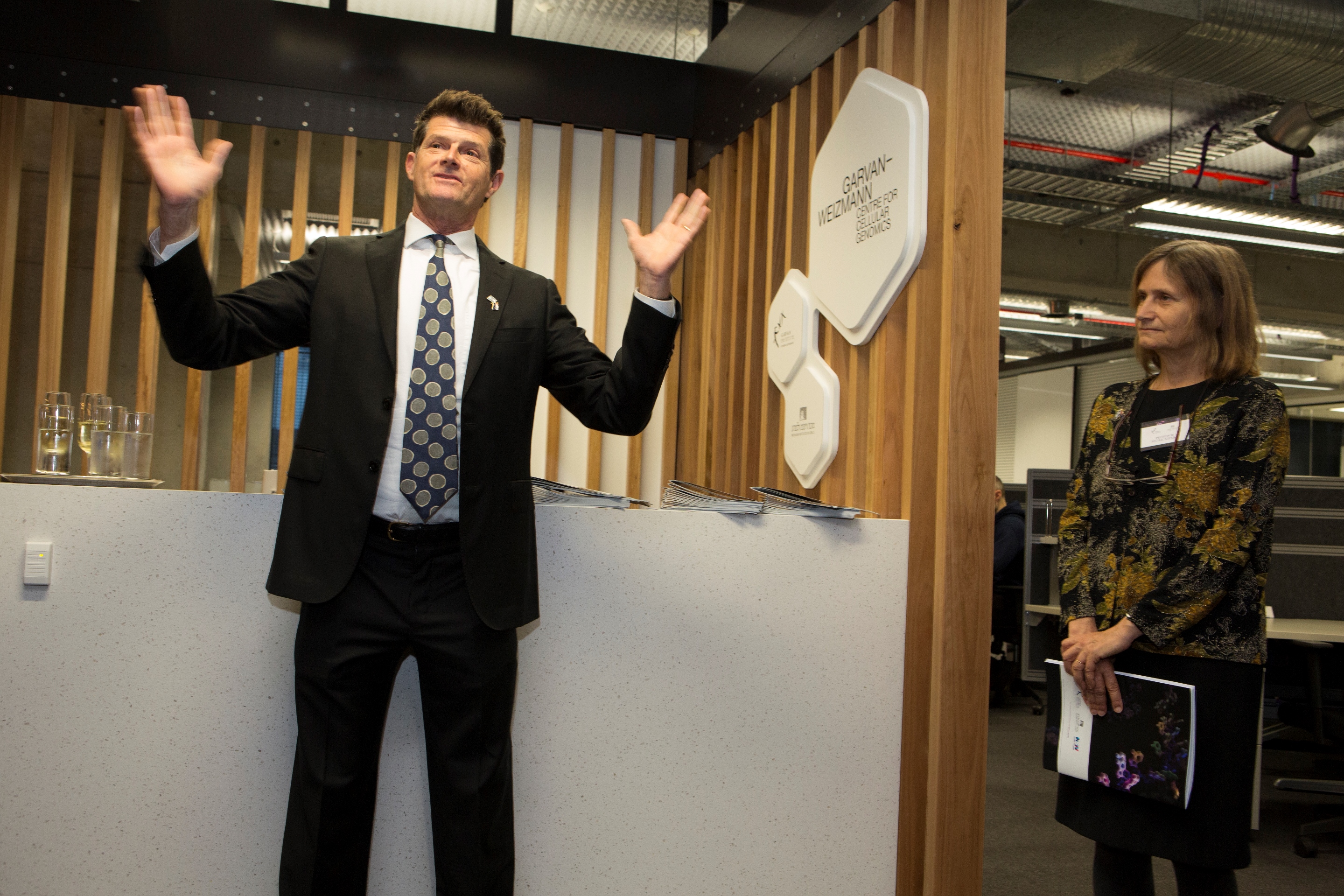
“Chris first came to Garvan as Deputy Director in 2015. In the three years he has been here, he has driven several exceptional research and clinical endeavours – most notably a close and wide-ranging partnership with Israel’s Weizmann Institute of Science – that are key to Garvan’s pioneering work in unlocking the power of precision medicine through genomics.”
Professor Goodnow said he was energised and inspired by those who had led Garvan before.
“Since its beginnings in 1963, this great Institute has benefited from outstanding leadership. The first full-time Director, Professor Leslie Lazarus AO, transformed Garvan into a major medical research institute and he was followed by Professor John Shine AC, an extraordinary pioneer of DNA research to improve human health who led the Institute into the era of genetics and genomics,” he said.
“More recently it was Professor John Mattick AO, who since 2012 has transformed the Institute into one of the world’s leading clinical genomics centres, and has positioned Garvan to make a major contribution to the transformation of medicine and healthcare. It’s my absolute pleasure to accept the Executive Directorship, and to build on the legacy of these pre-eminent leaders,” concluded Professor Goodnow.