
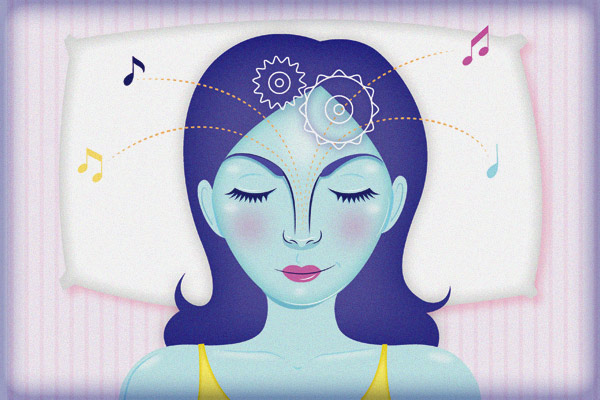
A new Weizmann Institute study has found that if certain odours are presented after tones during sleep, people will start sniffing when they hear the tones alone – even when no odour is present – both during sleep and, later, when awake. In other words, people can learn new information while they sleep, and this can unconsciously modify their waking behaviour.
Sleep-learning experiments are notoriously difficult to conduct. Prof. Noam Sobel and research student Anat Arzi, together with Sobel’s group in the Institute’s Neurobiology Department in collaboration with researchers from Loewenstein Hospital and the Academic College of Tel Aviv – Jaffa, chose to experiment with a type of conditioning that involves exposing subjects to a tone followed by an odor, so that they soon exhibit a similar response to the tone as they would to the odour.
The pairing of tones and odours presented several advantages. Neither wakes the sleeper (in fact, certain odours can promote sound sleep), yet the brain processes them and even reacts during slumber. Moreover, the sense of smell holds a unique non-verbal measure that can be observed – namely sniffing. The researchers found that, in the case of smelling, the sleeping brain acts much as it does when awake: we inhale deeply when we smell a pleasant aroma but stop our inhalation short when assaulted by a bad smell. This variation in sniffing could be recorded whether the subjects were asleep or awake. Finally, this type of conditioning, while it may appear to be quite simple, is associated with some higher brain areas – including the hippocampus, which is involved in memory formation.
In the experiments, the subjects slept in a special lab while their sleep state was continuously monitored. As they slept, a tone was played, followed by an odour – either pleasant or unpleasant. Then another tone was played, followed by an odour at the opposite end of the pleasantness scale. Over the course of the night, the associations were partially reinforced, so that the subject was exposed to just the tones as well. The sleeping volunteers reacted to the tones alone as if the associated odour were still present – by either sniffing deeply or taking shallow breaths.
The next day, the now awake subjects again heard the tones alone – with no accompanying odour. Although they had no conscious recollection of listening to them during the night, their breathing patterns told a different story. When exposed to tones that had been paired with pleasant odours, they sniffed deeply, while the second tones – those associated with bad smells – provoked short, shallow sniffs.
The team then asked whether this type of learning is tied to a particular phase of sleep. In a second experiment, they divided the sleep cycles into rapid eye movement (REM) and non-REM sleep, and then induced the conditioning during only one phase or the other.
Surprisingly, they found that the learned response was more pronounced during the REM phase, but the transfer of the association from sleep to waking was evident only when learning took place during the non-REM phase. Sobel and Arzi suggest that during REM sleep we may be more open to influence from the stimuli in our surroundings, but so-called “dream amnesia” – which makes us forget most of our dreams – may operate on any conditioning occurring in that stage of sleep. In contrast, non-REM sleep is the phase that is important for memory consolidation, so it might also play a role in this form of sleep-learning.
Although Sobel’s lab studies the sense of smell, Arzi intends to continue investigating brain processing in altered states of consciousness such as sleep and coma.
“Now that we know that some kind of sleep learning is possible,” says Arzi, “we want to find where the limits lie – what information can be learned during sleep and what information cannot.”
The study was published in Nature Neuroscience in August 2012.


